Address
E-Learning
Worldwilde
Address
E-Learning
Worldwilde

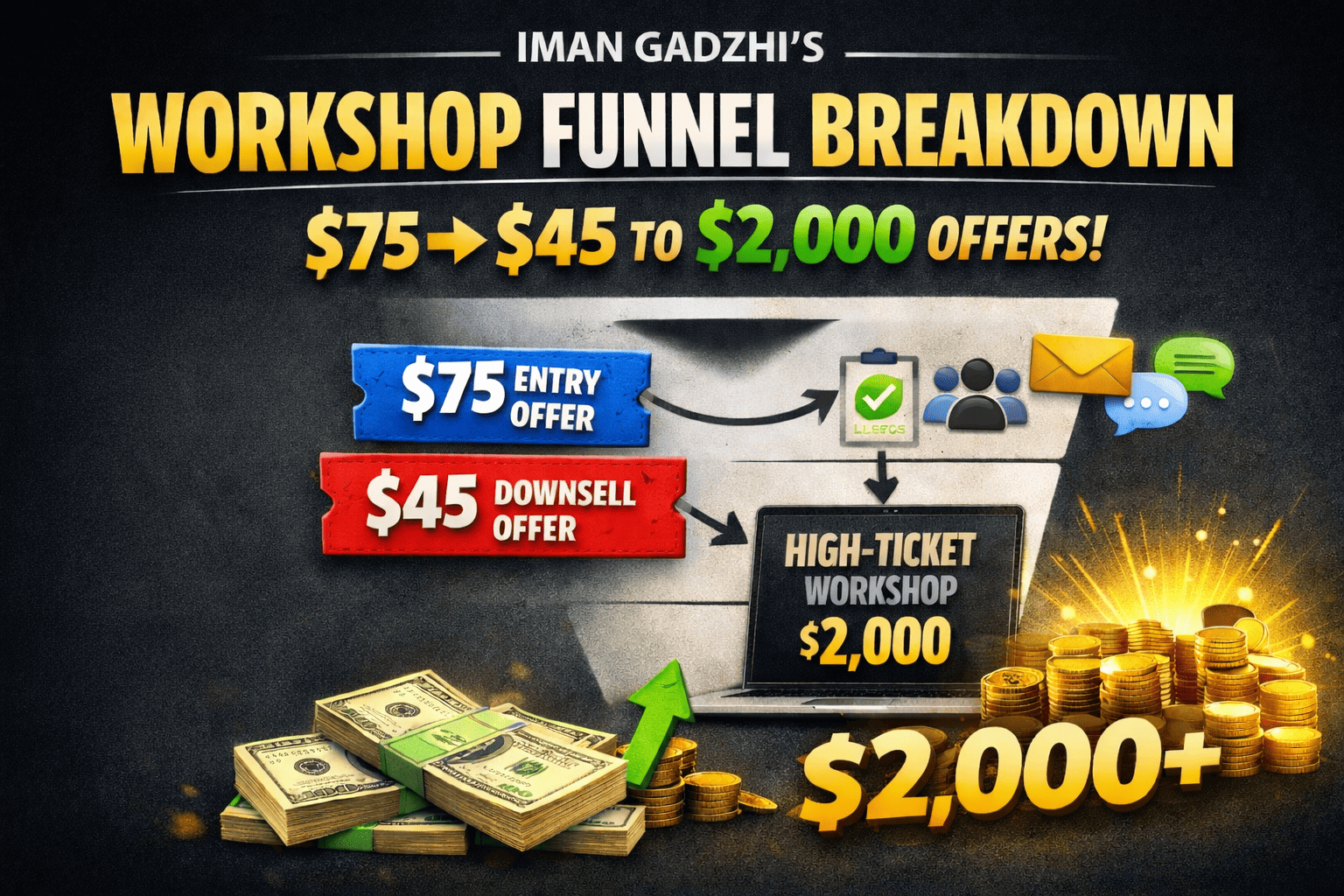
Discover how Iman Gadzhi workshop funnel, print money *(Full funnel breakdown)
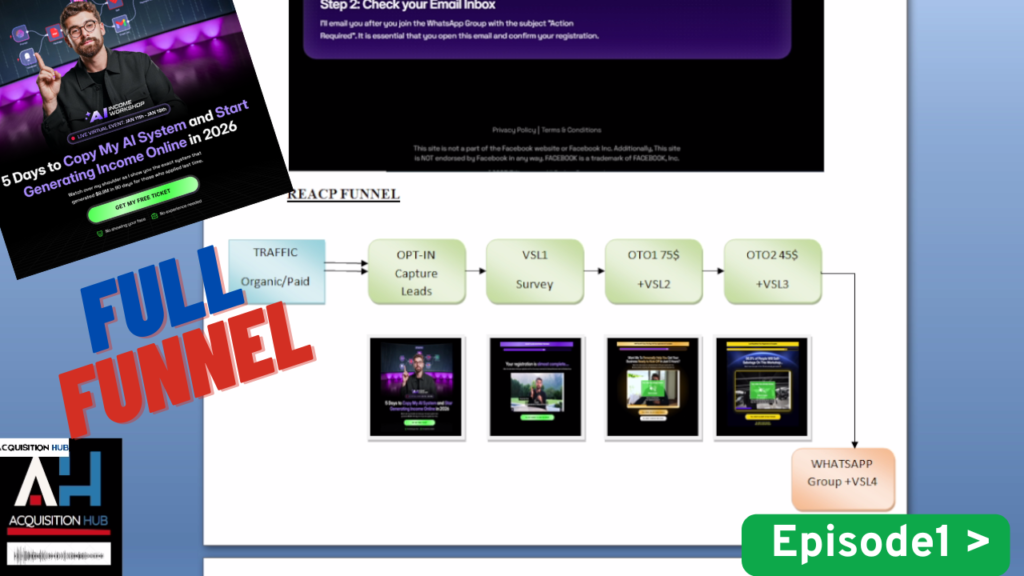
Most funnels fail before the pitch even happens.
Iman Gadzhi doesn’t rely on luck, motivation, or viral moments. He uses a precision-engineered funnel that filters, qualifies, and conditions prospects before they ever see a $2,000 workshop offer.
The secret?
A two-step low-ticket system combined with behavioral psychology.
In this breakdown, inspired by the Acquisition Realm video, you’ll learn exactly how Iman Gadzhi structures his funnel to:
If you sell services, courses, or workshops, this funnel is worth studying line by line.
Iman Gadzhi does not start with a free lead magnet.
He starts with a $75 low-ticket offer.
Why? Because free leads are cheap — and they behave like it.
The $75 offer serves one main purpose:
👉 Filter for buyers, not browsers
At this stage, the funnel isn’t trying to make profit. It’s trying to:
Once someone pulls out their card, even for $75, their mindset shifts:
They’re no longer “watching content” — they’re participating.
🧠 This is commitment psychology in action.
Here’s where the funnel gets surgical.
If the user declines the $75 offer, they don’t get kicked out.
Instead, they’re presented with a $45 downsell.
This does three powerful things:
✅ Recovers lost conversions
✅ Captures price-sensitive but serious buyers
✅ Keeps the user inside the ecosystem
From a funnel-operator perspective, this is genius:
💡 Important:
Both offers serve the same strategic goal — creating a buyer identity.
Free funnels optimize for volume.
Iman’s funnel optimizes for intent.
Let’s compare:
🔻 Free Opt-in Funnel
🔺 $75 → $45 Funnel
By the time prospects move forward, they’ve already:
This dramatically increases the conversion rate for what comes next.
After the low-ticket step, users are segmented based on:
This allows Iman’s team to:
Instead of one generic pitch, the funnel adapts to the buyer’s level of awareness.
This is why the workshop offer feels earned, not forced.
Only after commitment, payment, and qualification does the funnel introduce the high-ticket workshop.
At this point:
The workshop is positioned as:
The natural next step for people who want real results.
And because the funnel has already filtered out freebie-seekers, the sales process becomes clean, efficient, and scalable.
Iman Gadzhi doesn’t “sell harder.”
He filters smarter.
The $75 offer qualifies.
The $45 downsell recovers.
The workshop converts.
That’s not marketing hype — that’s funnel engineering.
If you want to build a similar system for your own business, services, or digital products, this is the blueprint.
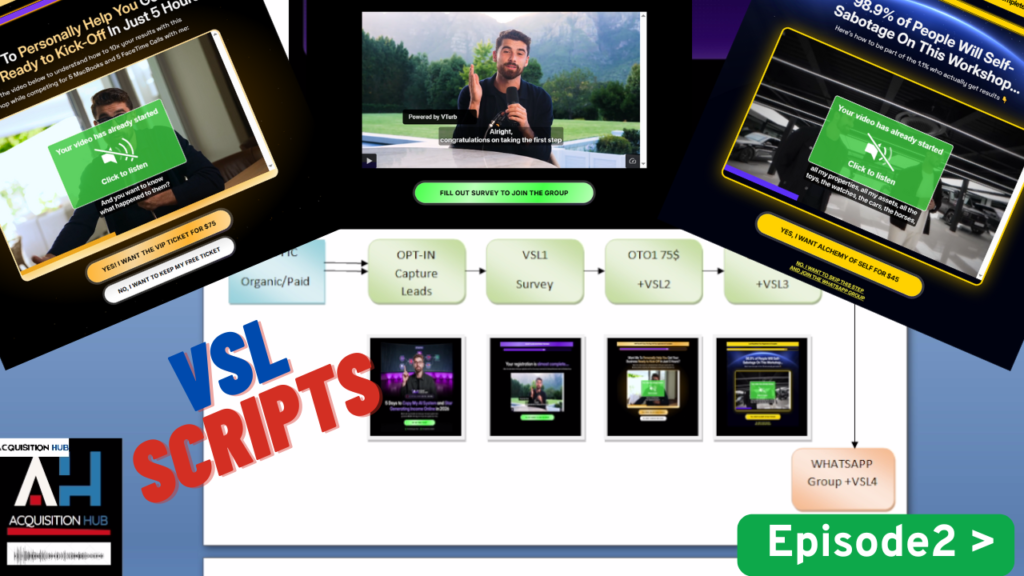
In modern digital marketing, the VSL (Video Sales Letter) is not content — it’s infrastructure. If your VSL is weak, no amount of traffic, retargeting, or “better offers” will save your funnel.
In a recent breakdown on Acquisition Realm, we analyzed the exact VSL scripts Iman Gadzhi is using to launch his upcoming 5-Day Workshop — and what’s happening behind the scenes is far more strategic than most marketers realize.
This funnel isn’t aggressive.
It isn’t hype-driven.
It’s engineered around commitment escalation, identity framing, and behavioral psychology.
Let’s break it down 👇
The first VSL in Iman’s funnel is not designed to sell the $2,000 workshop.
That’s the mistake most people make when they copy funnels.
This VSL exists for one reason only:
👉 to control attention and move the lead deeper into the system.
Instead of pitching, the script confirms registration, builds anticipation, and redirects the lead into a private WhatsApp group. This creates psychological ownership. Once someone joins a private channel, they stop behaving like a random lead and start acting like a participant.
This step alone dramatically increases:
Operator insight: A thank-you page is dead space. Iman uses his first VSL to reassign the lead’s environment.
After attention is secured, the next VSL introduces the first monetization layer — a $75 low-ticket offer.
This is not about revenue.
It’s about behavioral filtering.
At this stage, the script frames the $75 offer as:
The price is intentionally low enough to feel safe, but high enough to require intentional action.
Once someone pays $75, they’ve crossed the most important psychological threshold in marketing:
➡️ From consumer to buyer.
This single action reshapes how they perceive the rest of the funnel.
Here’s the key correction most breakdowns miss 👇
If the prospect says NO to the $75 offer, Iman does not let them leave.
Instead, the funnel immediately presents a $45 downsell.
This is a masterclass in resistance monetization.
The VSL reframes the objection:
By lowering the price — but not the value — the script captures buyers who hesitated, without damaging brand authority.
This step alone:
Operator insight: A downsell isn’t desperation — it’s segmentation.
What makes Iman’s VSL scripts so effective isn’t the offer — it’s the identity framing.
The language consistently divides the audience into two groups:
This isn’t manipulation — it’s alignment.
When someone buys, they aren’t buying content.
They’re choosing who they believe they are.
That’s why the VSL avoids technical details early and focuses instead on:
People don’t buy knowledge in uncertain markets — they buy clarity and momentum.
Most funnels die after opt-in.
Iman’s funnel does the opposite.
By pushing leads into WhatsApp, he gains:
Short follow-up VSLs and voice messages keep the lead emotionally engaged before Day 1 of the workshop even begins.
This dramatically increases:
Operator insight: Email nurtures interest. WhatsApp controls behavior.
This funnel works because it stacks three psychological layers:
This is why the funnel supports a $2,000 workshop without resistance.
Iman Gadzhi’s funnel doesn’t work because it’s flashy.
It works because every VSL has a job.
If you understand:
You can apply this structure to any niche, any offer, any market.
If you want more operator-level breakdowns, join the Acquisition Realm ecosystem — this is where funnels stop being guesswork and start becoming systems 💼🔥
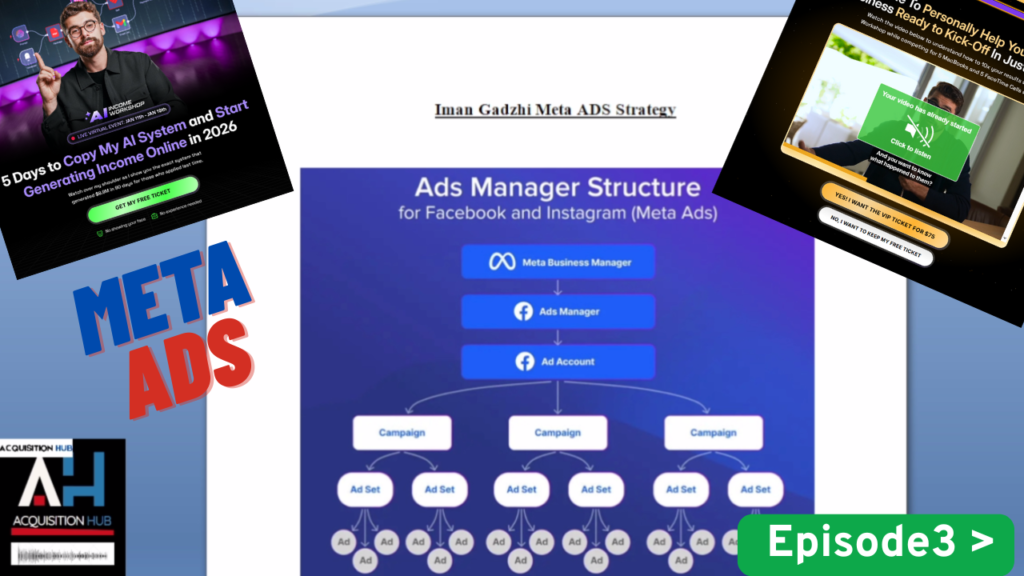
You can build the cleanest funnel, write the sharpest VSL, and structure perfect upsells — but without traffic, nothing moves.
That’s where most marketers fail.
In the final episode of the Acquisition Realm Iman Gadzhi Series, we break down the real engine behind his 5-Day Workshop launch:
👉 Meta Ads (Facebook & Instagram).
This is not “boost post” marketing.
This is a deliberate, scalable traffic system built on creative psychology, algorithm control, and ruthless optimization.
If you’re running Meta Ads (or planning to), this breakdown will show you why Iman’s ads convert, and how you can model the same logic without burning budget. 📊🚀
Iman Gadzhi does not run Meta Ads for “brand awareness” in the traditional sense.
Every campaign is built around one core goal:
👉 Lead Registration into the Workshop Funnel
From the first click, the ad’s job is simple:
🧠 Key Insight:
Iman isn’t chasing cheap leads — he’s chasing qualified intent.
In modern Meta Ads, audiences matter less than creative resonance.
Iman’s team understands this deeply.
Instead of over-engineering interests, they let the creative do the filtering:
📌 Media Buyer Rule:
If the creative is weak, no targeting will save it.
This is where Iman separates himself from 99% of advertisers.
His ads don’t scream:
❌ “Make money fast”
❌ “Join my free training”
Instead, they signal authority visually before saying anything.
Elements used:
🎯 Outcome:
Viewers assume value before hearing the offer.
One of the biggest reasons Meta Ads fail is broken message continuity.
Iman avoids this.
When someone clicks his ad:
📈 This is why his CPL stays stable even at scale.
Most advertisers scale like this:
“This ad works — let’s increase the budget.”
Then performance dies.
Iman’s team uses a Double-Down Scaling Model instead.
⚠️ Budget increases are supported by creative expansion, not hope.
Iman’s ad copy isn’t aggressive — it’s conviction-based.
He anchors:
💡 Important:
The ad pre-sells belief before the VSL ever loads.
Iman Gadzhi’s Meta Ads don’t sell the workshop.
They sell:
The real sale happens inside the funnel, but the ads decide who enters.
If your Meta Ads aren’t converting, it’s rarely the algorithm —
it’s the strategy behind the creative.
👉 learn more about funnel and stay tuned for the upcoming episodes.
👉 Strategy call here.
📩 Want to stay updated?
Join our free community and get notified when new tutorials, strategies, and resources drop.



I’d should check with you here. Which isn’t something I often do! I enjoy studying a submit that may make people think. Additionally, thanks for permitting me to remark!